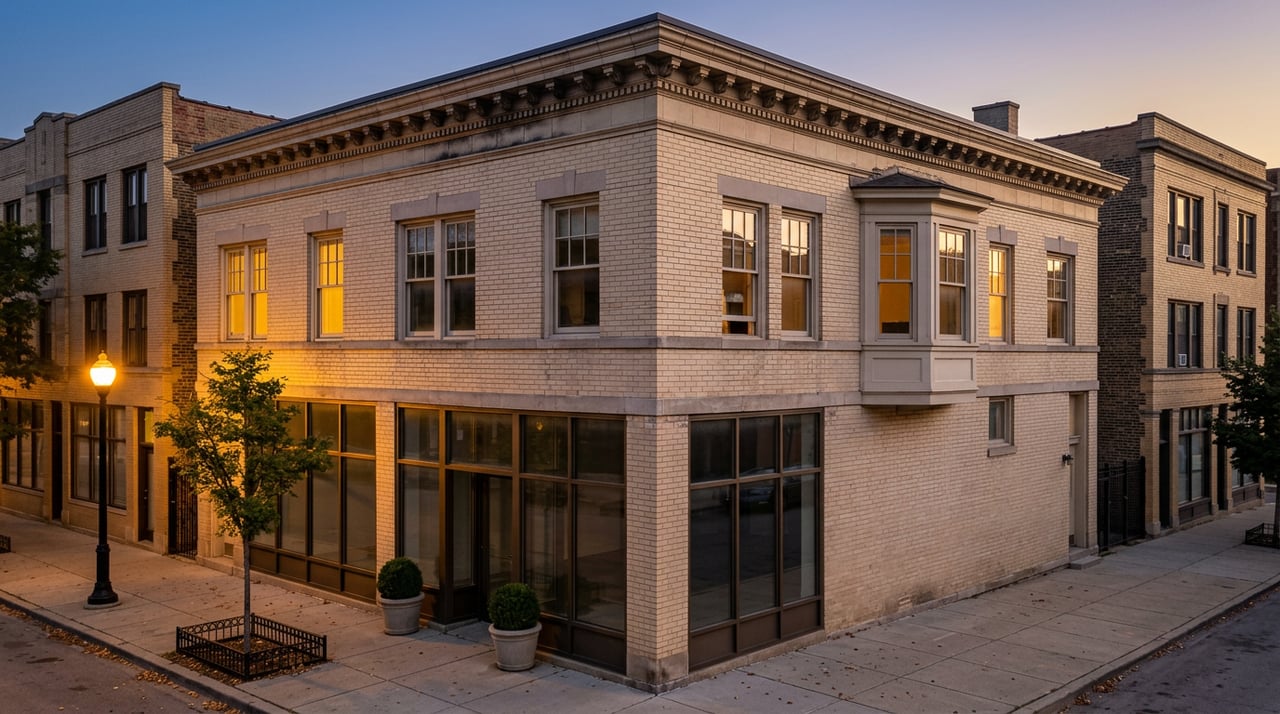
Walk south on Southport past Irving Park and the marquee is impossible to miss, eight neon letters spelling out MUSIC BOX above a building that has been showing films since 1929. What's easy to miss is the storefront right next to it. For nearly two decades that space belonged to Click Shoes & More, a boutique that built enough of a following that owner Paula Eisen described the closing as bittersweet when she shut the doors in December 2024. Now that storefront is part of the theater. It's Theater 3, and it opened in June 2026, the first expansion the Music Box has made since 1991.
That's the kind of detail a resident who's walked this block for years will notice without quite knowing what to call it. Here's what it is, and why it matters more than "the cinema added a room."
What Actually Filled the Space
The new auditorium sits at 3729 N. Southport Avenue, right next to the Music Box's main entrance at 3733 N. Southport. It seats 115 people, smaller than the 700-seat main house but roomier than the theater's existing second screen. The project cost about $2.5 million, partly covered by a $1.2 million Community Development Grant from the city. Building it also meant shortening Theater 2, the 1991 addition, to carve out a hallway connecting the lobby to the new room, and shifting that second screen to digital-only projection in the process.
The idea isn't new. Brody Sheldon, the co-owner and CEO of Music Box Theatre and Music Box Films, has said the expansion first came up in 2022 and got shelved for financial reasons. A strong programming year in 2023, along with growing pressure from distributors and filmmakers wanting space at the theater, brought the plan back. Sheldon framed the payoff plainly:
"We're constantly asked to host Chicago filmmakers and community events, and too often, we have to say no. This gives us the space to say yes more often."
That line does more work than it looks like. It's not marketing language about growth. It's an admission that for over three decades, a theater built to hold the city's independent, cult, and foreign film scene was turning people away for lack of a room.
The Squeeze That Made the Case
You don't have to take Sheldon's word for how tight two screens had become. You can watch it happen in April 2026, two months before Theater 3 opened.
That month, Beyond Fest, the largest genre film festival in the country, brought its first geographic expansion outside Los Angeles to the Music Box. Beyond Chicago ran four days, April 2 through 5, and packed 30 features across the theater's existing two screens. The schedule shows exactly what a two-screen ceiling looks like under real demand: on the same Friday night, Bob Odenkirk sat for a Q&A on Screen 1 while a sold-out world premiere with actor Meiko Kaji ran on Screen 2, RZA hosted a Shaw Brothers classic paired with his own new film, Lilly Wachowski appeared for a 4K restoration premiere, and a slate of 15 free MUBI-sponsored films got squeezed in wherever there was room. Multiple listings for that weekend read "Sold Out." The festival worked, but it worked by running both screens at capacity with no slack for anything else the theater might have wanted to program that same week.
That's the constraint General Manager Ryan Oestreich described a few months earlier, before the room existed. He'd said the third screen would let the Music Box hold word-of-mouth hits in theaters longer instead of pulling them for the next booking, and stop turning away filmmakers on press tours or local directors wanting a proper screening for their work. Beyond Chicago is the proof that this wasn't a hypothetical problem. It's what happens when a genre festival with 30 features meets a two-screen historic building.
What a Lakeview Local Notices This Season
The third screen has now been running for about three months, and the effect shows up less as a single big event and more as a calendar that no longer has to choose between things.
The clearest example arrives this fall with the Music Box of Horrors, the theater's annual 24-hour marathon, which starts at noon on Saturday, October 24, and runs into Sunday. Among the announced titles is Amityville II: The Possession, the 1982 entry directed by Damiano Damiani, with actor Diane Franklin appearing in person for a post-film Q&A. In past years, a marathon of this length running across two screens meant something else on the calendar had to wait its turn. This year it doesn't have to.
Alongside the horror marathon, the same stretch of calendar now holds room for:
- Crucemos al Otro Lado, a September series built around films by Latin American filmmakers and stories centered on Hispanic protagonists, described by the theater as embracing work from across the region rather than a single country or genre.
- Hong Kong Cinema Classics, a retrospective run in partnership with Shout! Studios and GKIDS, pulling from the catalog of essential Hong Kong genre and action filmmaking, part of the theater's expanded rotation of ongoing series.
- Animation Adventures, the theater's recurring series pairing nostalgic favorites with arthouse animation, which continues on its regular rotation rather than getting bumped by whatever else is booked that month.
None of these needs the third screen to exist on its own. What the third screen changes is whether they can all be on the calendar in the same stretch of weeks without one crowding out another, the way a horror marathon or a genre festival used to force everything else to wait.
The Part That's Easy to Miss From the Sidewalk
None of this required knocking anything down or changing the marquee. The building still looks like it did in 1929 from the street. The difference is what's happening past the ticket window: a theater that spent 35 years turning people away now has room to say yes, and the fall calendar is the first full season where that shows.
For what it's worth, the Music Box's ambitions haven't stopped at Southport Avenue either. The theater recently added The Heights Theater in Columbia Heights, Minnesota, to its operations, a sign that this expansion is part of something bigger than one building. But the version that matters for a Lakeview resident is the one three doors down from the old shoe store, now filling a room that didn't exist a year ago.
If you're the kind of person who already has Music Box screenings booked into your fall, you didn't need this piece to tell you the theater is good. What's worth knowing is that the reason this season's calendar feels less like a series of trade-offs is sitting in a storefront that used to sell shoes.
If any of this has you thinking more broadly about what's changing in Lakeview, from the businesses opening on Southport to the buildings around them, I'm always glad to talk through what I'm seeing on the ground. Let's Connect with Andy Ogorzaly.